

 Back to research
01 / Executive Summary
Western defense markets are undergoing a structural shift, not a cyclical one. For three decades the organizing principle was exquisite scarcity — a small number of high-cost, long-lived, technically dominant platforms, procured on long cycles and defended by deep political constituencies. That principle is now being displaced, unevenly and incompletely, by a blended architecture: a smaller exquisite core operating as sensing, command, and strike hubs, wrapped in scalable, attritable mass. We call the emerging design intelligent mass — affordable volume made militarily credible by autonomy, networking, and commercial production economics.
The investment consequence follows. Capital allocation, program design, and margin expectations were calibrated to value-per-platform; the frontier increasingly rewards cost-per-successful-mission, replenishment velocity, and software leverage across heterogeneous fleets — with durable value accruing to the orchestration layer that makes those fleets fight as one, not to any single platform. The distance between the two logics is where the most consequential capital-allocation decisions of the coming cycle will be made.
Three converging catalysts make the shift structural: combat consumption has exposed the fragility of the legacy industrial base; adversaries have industrialized cheap mass faster than Western institutions have responded; and cheap, networked systems have demonstrated strategic effects in every domain. Markets have begun to reprice — software-defined names trade at revenue multiples an order of magnitude above the primes, and defense-tech venture funding nearly doubled in 2025. What the market has not yet priced systematically is evidence: contested-environment performance is a distinct class of proof, and capital that can distinguish what has been shown from what has been proven will allocate through this transition better than capital that cannot.
02 / The Framework
The displacement is best read as a contest between two pricing logics. The incumbent logic prices value-per-platform: capability is a function of what a single system can do, and cost is justified by sophistication and survivability. The emerging logic prices cost-per-successful-mission: capability is a function of what a fleet can accomplish under attrition, and cost is judged against effect delivered, replenishment velocity, and the software leverage that compounds across units.
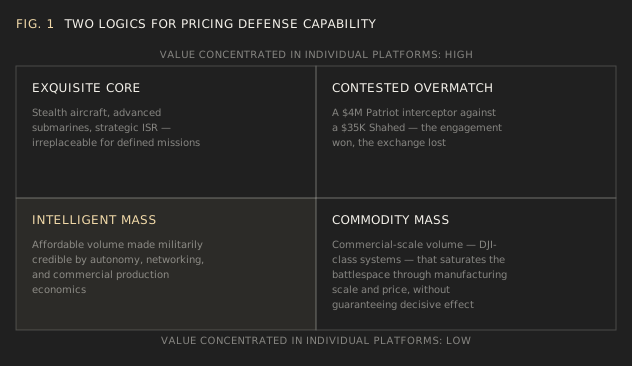
Vertical axis: cost per successful mission, low at the top to high at the bottom. Palisade Bergschrund framing.
The investment consequence follows from that shift. Capital allocation, program design, and margin expectations were calibrated to value-per-platform. The frontier increasingly rewards cost-per-successful-mission, replenishment velocity, and software leverage across heterogeneous fleets. The distance between those two logics is where we expect the most consequential capital-allocation decisions of the coming cycle to be made.
03 / Why the Old Paradigm Persisted
That historical pattern was not a mistake, but a rational fit for the environment that produced it. After the Cold War, the West enjoyed air dominance, faced no peer capable of sustained attrition, and prioritized survivability and precision in permissive theaters. Fewer, gold-plated systems — stealth aircraft, advanced submarines, strategic ISR — delivered overmatch while minimizing casualties and political exposure. The counterinsurgency era deepened the pattern.
Around this logic grew a self-reinforcing structure. Long acquisition cycles, prime-centric programs, and export regimes optimized for a handful of flagship platforms. Those platforms anchored budget baselines, sustained industrial employment, and signaled resolve. The result was a system whose incentives — procurement, political, and financial — all pointed toward fewer and more expensive. Affordable mass was not overlooked so much as crowded out; it had no constituency. That same inertia now slows the transition: the paradigm is shifting because operational reality has moved, not because the institutions chose to.
04 / The Catalysts
The forces driving the shift are converging; the combination is what makes it structural.
The first is combat consumption exposing the industrial base. Before February 2022, the United States produced roughly 14,000 155mm artillery shells per month — a baseline concentrated in a single Scranton facility, with load-assembly-pack at one Iowa plant. Army acquisition leadership later described that footprint publicly as a handful of buildings whose loss would have halted production entirely. Ukrainian consumption, estimated in the tens of thousands of rounds monthly at peak, rendered that baseline untenable within weeks. The Pentagon committed roughly $1.45 billion to facility expansion and $1.5 billion in awards across domestic and allied producers, with public plans targeting 100,000 rounds per month by 2025–26 — roughly seven times the pre-war baseline. Actual output by mid-2025 is assessed at approximately 40,000 rounds per month, about three times the baseline but still materially below the stated target, with officials noting slippage into 2026. The significance is not the shells. It is that combat consumption reordered procurement architecture inside eighteen months, forcing the first sustained, baseline-high munitions commitment since the Cold War.
The second is adversarial industrialization of cheap mass. Russia began importing Iranian Shahed-136 loitering munitions in 2022; leaked Iran–Russia contract documents, disclosed in early 2024, set an initial price near $375,000 per unit before bulk discounts — roughly $290,000 per unit at 2,000 units, and $193,000 per unit for the 6,000-unit order Russia ultimately agreed to under a roughly $1.75 billion technology-transfer deal. Russia then localized production at its Alabuga facility, and by 2025 intelligence-linked and think-tank assessments place the unit cost in a $35,000–$70,000 range, depending on configuration and source. Production volume tells the structural story: from an estimated 2,700 units in 2023 to roughly 2,700–3,000 per month by late 2025, against an estimated Alabuga capacity ceiling of 5,000–5,500 per month — and in May 2026, a record 8,161 Shahed-type launches in a single month, decoys included, per third-party analysis of Ukrainian air force data, before volume eased in June. These are leaked and OSINT-derived figures, not audited ones, and should be read as ranges.
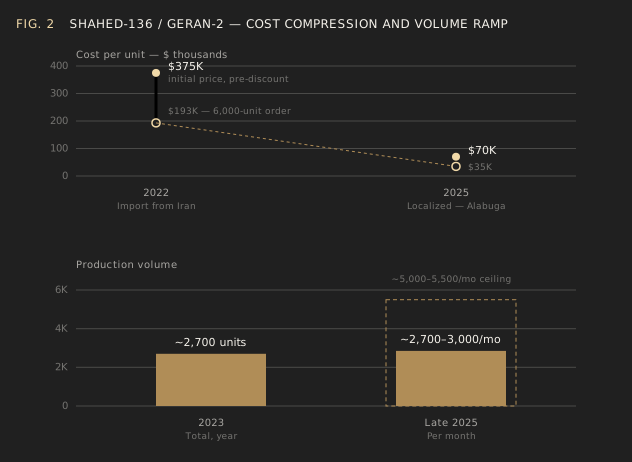
Import pricing from leaked Iran–Russia contract documents (disclosed Feb 2024; single source): $375K initial, $290K at 2,000 units, $193K for the 6,000-unit order agreed under a ~$1.75B technology-transfer deal. Localized costs and volumes are intelligence and think-tank assessed ranges. As of July 2026.
That price sequence is the signal, not the shells or the drones themselves. A peer competitor chose production capacity over unit sophistication, accepted early cost premiums to stand up a supply chain, then rode the cost curve down. First-mover production investment creates a compressing cost curve that latecomers cannot easily replicate — a lesson that applies to capital as much as to munitions. The defensive side of the ledger has begun to run on the same economics: in February 2026, Ukraine’s commander-in-chief reported that interceptor drones accounted for more than 70% of Shahed kills over Kyiv, at a cited cost near $2,500 per Ukrainian-built Sting interceptor against roughly $4 million for a Patriot PAC-3. The figures are commander-reported, and interceptors address a subset of aerial threats rather than replacing high-end air defense — but the cost exchange now runs both ways.
The third catalyst is field proof that cheap, networked systems can produce strategic, not merely tactical, effects — across every domain. The clearest maritime case is Ukraine’s unmanned surface vessel campaign against the Russian Black Sea Fleet, prosecuted without a commissioned warship. The economics are stark: a Magura-class or Sea Baby USV costs an estimated $220,000–$260,000 per unit, while the vessels it has removed run from tens of millions of dollars for a corvette or patrol ship to well over $100 million for a landing ship. Reconstructing confirmed strikes since mid-2023, Ukraine’s cumulative USV expenditure runs to an estimated $16 million against roughly $750 million in Russian naval assets destroyed or disabled — a cost exchange on the order of 47 to 1. That figure is deliberately narrow: it excludes assets destroyed by other means, most notably the missile cruiser Moskva, sunk by Ukrainian Neptune anti-ship missiles in 2022, so the ratio reflects USV strikes against their own targets rather than the full tally of Black Sea Fleet losses. Sustained pressure of this kind, alongside the wider missile and air campaign, contributed to the fleet’s redeployment away from Sevastopol — ceding sea denial across the basin to a country without a conventional navy.
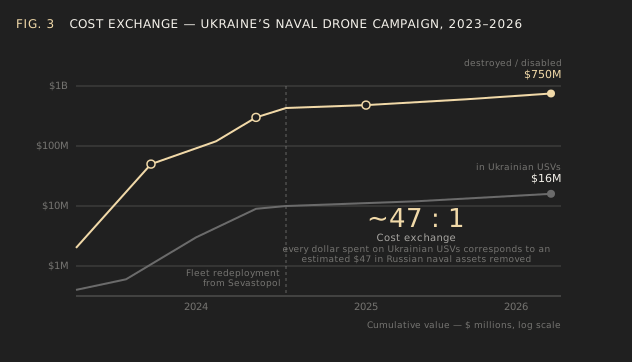
Marked points on the upper curve are a landing ship damaged; a corvette, landing ship and patrol ship sunk; and two fighter aircraft downed. Illustrative reconstruction from confirmed strikes; data points marked, curve smoothed. Costs and target values are analyst/media estimates, not audited. USV-attributed losses only — excludes assets destroyed by other means (e.g. the Moskva). As of July 2026.
The air-domain analogue arrived on June 1, 2025. Operation Spiderweb — the strike by Ukraine’s Security Service against four Russian strategic bomber bases, Olenya, Belaya, Dyagilevo, and Ivanovo-Severny, across five time zones — used 117 FPV quadcopters, smuggled into Russia inside disguised truck containers and launched remotely after eighteen months of covert preparation. No Ukrainian aircraft crossed the border. The airframes were commercial derivatives costing an estimated $500–$2,000 per unit, flying open-source autopilot software, with target recognition trained on museum aircraft; the insertion vector was a fabricated Russian logistics company.
No official cost disclosure exists; a reasoned all-in program estimate — covert logistics included — runs $1–5 million. Against that, satellite imagery and Western officials confirm at minimum ten to thirteen strategic aircraft destroyed, a conservative replacement value near $600 million; Ukraine claims 41 aircraft affected and damages exceeding $7 billion, a figure corroborated in aircraft count but not in methodology. Even the imagery-verified floor yields a cost exchange on the order of 200 to 1. The strategic residue extends past the aircraft: none of the types struck are in meaningful production, and Russia’s response — dispersal across more than a dozen airfields, hardened-shelter construction, relocation of the bomber fleet — is a continuing cost imposition that materially exceeds the cost of the operation that triggered it. Strategic depth, the foundational assumption of Russian basing doctrine, was invalidated by commodity hardware and open-source software.
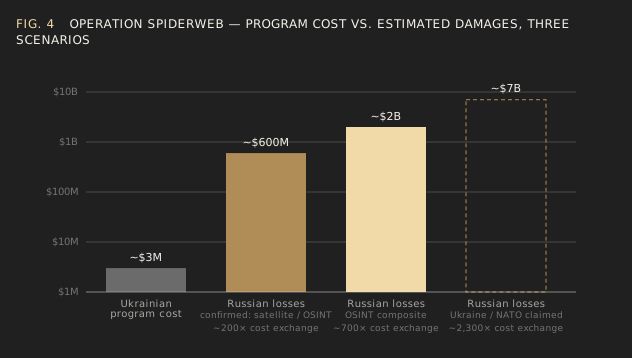
Program cost is a reasoned estimate, not an official disclosure. Scenarios: 10–13 aircraft confirmed via satellite/OSINT imagery; 20–25 per OSINT composite; 41 claimed by Ukraine/NATO. The outlined bar denotes the least-verified figure. As of July 2026.
The strategic effect of those campaigns is the point: field demonstration, not program promise, moves force planning — and investor capital has followed the same logic. Saronic priced a $600 million Series C at a $4 billion valuation in 2025, then closed a $1.75 billion Series D at a $9.25 billion valuation in March 2026 — more than doubling its valuation within roughly a year on the strength of scaling production and a U.S. Navy production contract, not prototypes. The operational record has kept pace with the capital: in June 2026, a Saronic Corsair USV operated by U.S. Navy Task Force 59 — the Navy’s unmanned-systems task force — carried out the first known unmanned-surface-vessel search-and-rescue mission, recovering two U.S. Army aviators downed off Oman; in July 2026, three Corsairs took part in U.S. strikes on an Iranian naval base, marking the platform’s first combat use. The same vessel moving from reconnaissance to rescue to strike within a matter of months is the intelligent-mass thesis in miniature — capability compounding through use, priced by investors in near-real time.
Underneath the operational lessons sit the enabling technologies that convert cheap into credible: machine learning and collaborative autonomy; additive and modular manufacturing; resilient LEO ISR and communications; and commercial off-the-shelf components that lower cost while introducing exposure that must be underwritten, not assumed away. The decisive variable among them is software leverage. When value migrates into autonomy stacks, decision-support, and battle-management that port across airframes and hulls, it decouples from any single platform — and that decoupling is what turns a hardware transition into a change in the shape of the value chain.
Finally, the competition is not waiting. Peer actors are building layered arsenals that pair low-cost inventories with advanced fires, investing in production capacity and command architecture optimized for attrition. The risk to Western forces is not qualitative parity; it is being structurally out-scaled in a protracted fight.
05 / The Orchestration Thesis
Intelligent mass is not a substitute for the exquisite core. It is an architecture in which the exquisite core becomes more effective — and more survivable — because it is no longer asked to do what volume can do better and cheaper.
The transition is best understood as a system-of-systems restructuring rather than a hardware swap. The exquisite core — advanced submarines, strategic ISR platforms, stealth aircraft — retains irreplaceable functions: deep-strike penetration, strategic sensing, contested-airspace access, and the command architecture that makes mass coherent. What changes is the ratio and the logic. The exquisite core is a scarce, expensive hub; the attritable layer provides the volume, the distributed sensors, and the expendable strike capacity that absorbs attrition and saturates defenses; and the orchestration layer — the software that makes heterogeneous fleets function as one — is where enterprise value compounds.
The evidence for this framework is now operational rather than theoretical. Artillery replenishment exposed the industrial fragility of exquisite-only postures; the USV campaign demonstrated a 47-to-1 cost exchange against naval assets; Spiderweb demonstrated that strategic-depth assumptions built on physical distance can be invalidated by attritable systems and commercial technology. Taken together, these are not anomalies. They are the reference architecture for the next planning cycle.
06 / The Evidence Base
The operational record is now dense enough to anchor capital theses rather than merely inspire them — and the cases above share a structure. In each, the decisive fact was established in the field, not in the program office. Demonstration performance and field performance are not the same evidence: a demonstration establishes what a system can do under conditions chosen to favor it; field performance establishes what survives contact — jamming, deception, attrition, and an adversary adapting in real time. In Ukraine — the most combat-tested defense market in the world — validation by presentation has been displaced by validation in combat. In an intelligent-mass architecture, where effect depends on many cheap systems functioning under exactly those pressures, the gap between the two is the difference between intelligent mass and commodity mass.
The cost-exchange record is the first category of evidence. Across the domains examined — artillery, maritime drones, interceptors, long-range strike — the pattern is consistent: attritable systems impose losses at exchange ratios running from roughly 20 to 1 to well over 2,000 to 1 at the extreme. The ratios are not uniform, and they move as countermeasures adapt. But the floor, under conservative, imagery-verified accounting, remains asymmetric enough to constitute a structural argument for mass at the margins of contested confrontation.
Contested-environment evidence is also perishable — the second thing the record shows. In Ukraine’s FPV counter-EW loop, a system validated one month can be defeated the next; fiber-optic control bypassed radio-frequency jamming within a single adaptation cycle. Perishability raises rather than lowers the value of current field evidence produced under known conditions: a static certification decays, while a validation loop compounds. The implication is that combat evidence carries a term structure. A result is a property of the system under specific conditions at a specific time, not of the system itself — and underwriting that ignores the date and conditions of the proof is underwriting a different asset than the one being bought.
Markets are pricing the transition in real time, if not yet the evidence discipline underneath it. Software-defined names trade at a different altitude from the traditional primes: Anduril’s $61 billion valuation following its May 2026 Series H implies roughly 28 times its company-reported 2025 revenue of $2.2 billion, and Palantir’s price-to-sales ratio stood near 60 times as of mid-July 2026 — against Lockheed Martin near 1.6 times, Northrop Grumman near 1.8, Boeing near 1.9 on a total-company basis, and RTX near 3.0, lifted by its commercial-aerospace mix. Multiples move quickly; treat this as a snapshot as of July 14, 2026, not a standing figure.
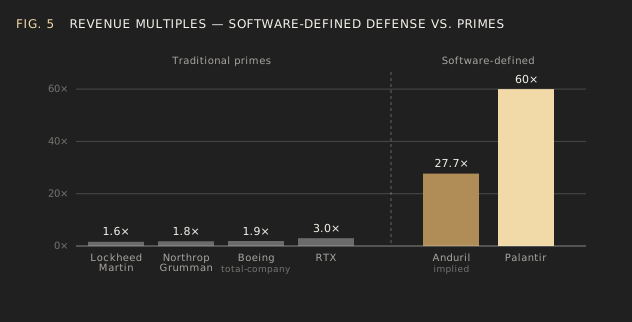
Anduril: $61B valuation (May 2026 Series H) / company-reported $2.2B 2025 revenue. Palantir: trailing P/S as of July 14, 2026 (S&P Global via StockAnalysis). Primes: total-company trailing P/S as of July 13–14, 2026 — Boeing is total-company, not defense-segment. Multiples move quickly; snapshot as of July 14, 2026.
Private capital shows the same pattern, and its composition matters as much as its size. PitchBook puts 2025 defense-tech venture funding at $49.9 billion across 966 deals, up from $27.3 billion across 859 deals in 2024 — an 83% increase — with autonomy, sensing and security, and compute-adjacent software capturing the largest share of deployed capital. Roughly 87% of that capital flowed into venture-growth and late-stage rounds — a concentration on scaled execution, production capacity, and deployment cadence rather than exploratory prototyping. Exit liquidity followed, with 2025 exit value reaching roughly $54.8 billion against $18.2 billion in 2024. The largest platform rounds of the period — Anduril, Shield AI, Saronic — were priced closer to software-leverage platforms than to traditional hardware primes, and analysts commonly attribute part of the shift to combat validation of autonomous systems in Ukraine, though the causal weight of any single factor is difficult to isolate. The supply side, meanwhile, is running ahead of funded demand: Kyiv School of Economics estimates place Ukraine’s 2025 production capacity near $35 billion — rising toward $55 billion in 2026 — against roughly $6.8 billion in funded contracts, a gap that makes export, co-production, and allied procurement the structural release valve.
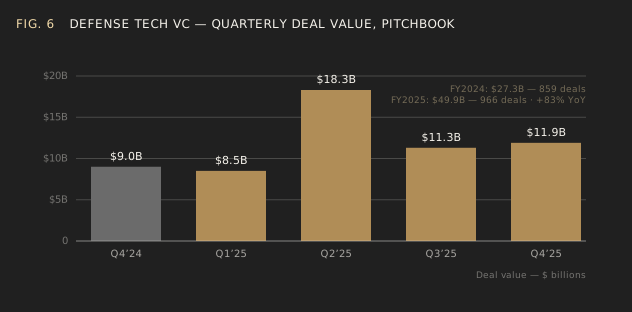
Source: PitchBook, Q4 2025 Defense Tech VC Trends (published Feb. 9, 2026). Global deal value; 2026 quarters not yet available in this dataset.
What is still missing is a systematic discipline for grading the evidence itself — under what conditions a result was produced, how recently, and against what threat configuration. That discipline, more than any single dataset, is what will separate allocators who can underwrite this transition from those who cannot.
07 / Second-Order Effects
The consequences that matter for capital are downstream of the operational shift.
Government budgets migrate from CAPEX toward OPEX — and toward more flexible contracting — as policy attempts to keep pace. Exquisite postures concentrated spending in high-ticket, long-lifecycle hulls and airframes; intelligent mass shifts the balance toward sustained replenishment — munitions above all — with lifecycle spending increasingly weighted toward maintenance and interoperability across fleets rather than the platforms themselves. This need not fundamentally change the sector’s cash-flow profile: government contracting remains inherently lumpy, and funding still arrives in tranches rather than smooth recurring revenue. What it does change is relative advantage. Firms built for rapid iteration, interoperability, and high-throughput production can deliver at meaningful scale — thousands of units on compressed timelines — while traditional program design and acquisition cycles move more slowly, and that speed gap is where share shifts.
Program and acquisition design follow, more slowly. Stockpile depletion, adverse cost-exchange, and interoperability needs are forcing shorter timelines, multi-year munitions buys, and more flexible sales structures. Newer contracting authorities and procurement mechanisms — expedited pathways such as Other Transaction Authorities, alongside middle-tier acquisition programs — are giving government buyers more room to purchase at the cadence intelligent-mass producers can actually deliver, reinforcing the shift from the demand side. Progress is real but gated by the political economy of prestige platforms and by the ordinary inertia of government bureaucracy. Investors should treat acquisition reform as a probabilistic tailwind, not a scheduled event, and price the timing risk accordingly.
Margin structures bifurcate. Attritable hardware trends toward commoditized, lower-gross-margin production, defensible through scale and supply-chain control. Software and autonomy retain high-margin, compounding economics with real switching costs. Durable enterprise value accrues to whoever controls the orchestration layer — the software that makes heterogeneous fleets useful together — not to the marginal airframe. This reshapes the venture-versus-prime dynamic: primes retain the exquisite core and integration authority, but the connective tissue — C2/ISR fusion, portable autonomy, low-cost layered defense, distributed manufacturing, contested-environment sustainment — is where new entrants can build category-defining positions before incumbents reorganize.
The company-level filter is survivability under fire. Performance that holds under contest separates intelligent mass from commodity mass — and separates producers worth a premium from hardware that commoditizes faster than most models assume. The symmetrical error is overcorrection: high-end interceptors, strategic ISR, and command platforms remain irreplaceable for a defined set of missions, and treating mass as a universal substitute is as costly as ignoring it. The investable thesis is the blended architecture, and the orchestration layer that makes the blend coherent.
08 / Implications for Capital Formation
For allocators, the record argues for capability-centric rather than platform-centric underwriting. The relevant question is not what a system costs, but what scalable effect it creates across multiple platforms and customers — and whether that effect has been validated where it will actually be used. Three principles follow. First, underwrite the orchestration layer, where value compounds and switching costs are real: hardware that plugs into a dominant autonomy stack is worth more than hardware that does not, and the stack itself is worth most. Second, price supply-chain exposure explicitly — COTS dependence on adversarial-nation inputs, chokepoint materials, and contested geographies are underwriting variables, not footnotes, and cost-per-unit without a provenance adjustment overstates the value of a position. Third, treat contested-environment validation as a distinct category of evidence, graded on condition, recency, and threat configuration rather than accepted as a binary; systems proven in Ukraine-like conditions are becoming reference points for Indo-Pacific planning.
Capital that can distinguish what has been shown from what has been proven should be better positioned to allocate through this transition than capital that cannot. The structural shift in defense is, at bottom, a shift in what counts as evidence — and independent validation is one useful discipline for making that distinction systematically as the market continues to reprice around it. Allocators who internalize the new standard first will set the prices everyone else trades against.
Glossary of Acronyms
- LEO
- Low Earth Orbit — the satellite band (roughly 160–2,000 km altitude) used for resilient ISR and communications constellations.
- C2
- Command and Control — the systems and processes through which military operations are directed and coordinated.
- ISR
- Intelligence, Surveillance, and Reconnaissance — persistent sensing and data collection supporting targeting and situational awareness.
- CAPEX
- Capital Expenditure — upfront spending on long-lived assets such as platforms, hulls, and airframes.
- EW
- Electronic Warfare — the use of the electromagnetic spectrum to jam, spoof, deceive, or detect adversary systems.
- OPEX
- Operating Expenditure — recurring spending on production, consumables, maintenance, and sustainment.
- FPV
- First-Person View — a drone flown via a live onboard video feed, commonly used for low-cost precision strike.
- OTA
- Other Transaction Authority — a flexible U.S. defense contracting mechanism outside standard federal acquisition regulations, used for rapid prototyping and follow-on production.
- USV
- Unmanned Surface Vessel — a crewless maritime drone operating on the water’s surface.
- SBU
- Security Service of Ukraine — Ukraine’s principal internal-security and counterintelligence agency, executor of Operation Spiderweb.
- COTS
- Commercial Off-The-Shelf — components or systems sourced from commercial markets rather than purpose-built for defense use.
- PAC-3
- Patriot Advanced Capability-3 — the hit-to-kill interceptor missile fired by the Patriot air-defense system.
This document is provided for informational and discussion purposes only and does not constitute investment advice, a solicitation, or an offer to buy or sell any security. Data, estimates, and projections are drawn from publicly available sources, including OSINT analysis, think-tank assessments, and reported financial figures; they are not independently audited and should be treated as ranges rather than precise values. References to specific companies are illustrative and do not constitute a recommendation.
