
 Back to research
01 / Executive Summary
Allied defense-technology markets are being rebuilt in real time — the technology still evolving in the field, the rules for trading it written in parallel through bilateral frameworks, export decrees, and common standards — and access now runs through state-built market pathways rather than through products alone. Two are operating. Ukraine’s Drone Deal converts a wartime learning curve into bilateral export partnerships: nine signed as of July 7, with IP retention written into Ukraine’s export regime rather than negotiated per deal. The U.S. counter-drone marketplace run by Joint Interagency Task Force 401 (JIATF-401) pools allied demand behind a single catalog and a common data standard: five procurement-enabling agreements, nine more nations by statement of intent, and a stated target of twenty-five by summer’s end.
These regimes are new enough that most operators and investors are not yet factoring them into go-to-market or diligence conversations. The nearest opportunity is the integration, training, and sustainment layer each new signing opens — but that layer is downstream of the bilaterals themselves, so the near-term work is stakeholder alignment: engaging, through commercial and military-diplomatic channels alike, the government offices writing these agreements. Localization and industrial-offset requirements will do the sorting: understanding them is a competitive advantage only for firms with the partnerships already in place to act on the pathways each agreement opens. The nearest risks are licensing throughput — a signed bilateral is not a shipped system — and a reciprocal marketplace channel that does not yet exist. The pages that follow map both pathways and what to watch.
02 / A Market Built by Decree
Markets usually form first and get regulated later. This one is doing both at once: the technology is still taking shape in the field, the rules for trading it are being written in parallel, and each is pulling the other forward. The pathways by which battlefield-proven technology crosses allied borders were redrawn between January and July by deliberate acts of statecraft — a controlled-export framework and then a fast-track export decree in Kyiv, a counter-drone task force and a common data standard in Washington. None of this was the market finding its own level — and rules written this fast can be rewritten just as fast. The consequence is timing: the rules are being written as the market forms, and position is set now or set by someone else.
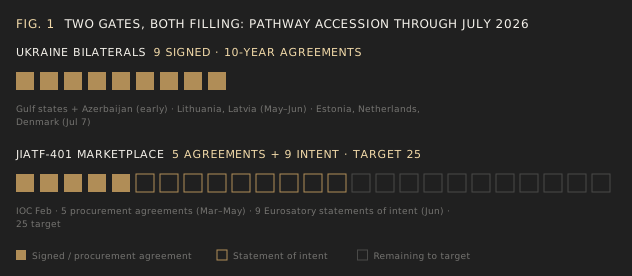
Accession tally as of July 2026. Ukraine: nine ten-year bilateral agreements signed (as of July 7). JIATF-401: five procurement-enabling agreements plus nine Eurosatory statements of intent, against a stated marketplace target of twenty-five. Per public reporting as of July 15, 2026.
03 / Ukraine
Ukraine’s Drone Deal is not an arms-export program. It is the conversion of a learning curve into statecraft. The framework — presidential-level, coordinated through the National Security and Defence Council, run under the Build with Ukraine umbrella — bundles what four years of high-intensity war produced: combat-proven designs, operator doctrine, production know-how, and increasingly the battlefield data itself. Nine ten-year agreements are signed: the Gulf states and Azerbaijan early, Lithuania and Latvia in May and June, and Estonia, the Netherlands, and Denmark at Ankara on July 7. Germany and Norway hold adjacent bilaterals: Germany the DELTA battlefield-data memorandum and drone-production implementing arrangements, Norway licensed drone production backed by a pledge of more than $1.5 billion for Ukrainian-made systems. Germany has proposed a full framework agreement; Norway has signed a joint declaration as a first step toward one. The queue behind the nine is the tell: twenty-seven countries, per Zelensky’s mid-June count, are engaged at some stage of the wider initiative.
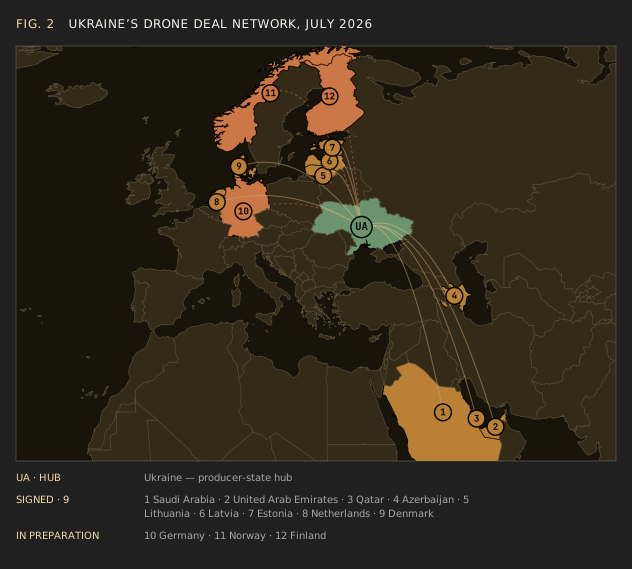
Producer-state hub (Ukraine), signed ten-year agreements, and partners in preparation. Europe and Gulf framing; North American partners (Canada, in preparation; United States, testing) are listed in Appendix A. Status per public reporting as of July 15, 2026.
The July 1 Fast Track decree is the structural event, because it moved the framework’s terms from diplomacy into law. Export-permit review drops from ninety to thirty days for non-critical items sold to framework partners. IP rights never transfer; technology moves under use-license only, re-export requires Kyiv’s written consent, and twenty percent of the value of finished-product exports — thirty for components — flows to a dedicated state budget fund for the defense industry. The levy falls due at application, with no refund if the permit is refused — a term-sheet variable in its own right. Domestic contracts outrank exports on pain of revocation.
Ukrainian producers now hold a statutory revenue claim on downstream commercialization, and the question in every co-production negotiation has changed from whether IP is protected to where the levy sits in the term sheet. Throughput, not announced demand, is the binding constraint on revenue here: a signed bilateral is not a shipped system, and the decree is untested at volume.
The decree also enforces a distinction firms should have been making anyway: design edges travel in co-production; iteration edges stay home. A manufacturer whose edge is the design will watch co-production transfer it — blueprints travel. A manufacturer whose edge is the iteration loop — field, observe, adapt, refield — loses far less, because the loop stays home with the engineers and the data. The use-license regime now polices that boundary by statute. The quieter opportunity sits beside it: each signing opens a country where training, integration, and sustainment capacity is thin, demand lands with the deal, and no IP changes hands. Localization and industrial-offset requirements shape who captures it — the firms holding in-country partnerships when an agreement lands convert the opening; late arrivals negotiate from the queue. The commercial treatment of battlefield data as a traded asset is taking shape the same way — worked out agreement by agreement rather than settled in advance.
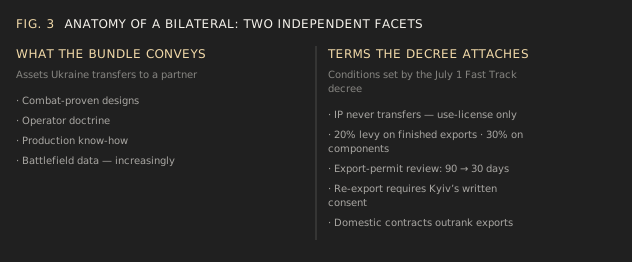
Two independent facets of a bilateral agreement, shown side by side: the assets conveyed (left) and the legal terms governing any transfer (right). The two lists are separate — items are not paired row-for-row. Per public reporting as of July 15, 2026.
Where market power concentrates is clearest in the one deal still open. Washington has not signed the framework. As of July 9 it holds signed testing-access documents and is evaluating Ukrainian aerial and maritime systems — with positive feedback, per Kyiv — and is reported to be seeking IP and technology transfer rather than data access. The most powerful buyer would rather own the learning curve than rent it. A joint-production venture Zelensky has valued at $35–50 billion hangs on that question, which is to say on politics.
04 / United States (JIATF-401)
The second pathway inverts the first. Where the hub writes bilateral terms outward, Joint Interagency Task Force 401 — the Pentagon’s central authority for the counter-drone mission since 2025, and the institution most non-U.S. suppliers have never heard of — aggregates buyers inward behind a standard. Its marketplace reached initial operating capability in February on an existing catalog; five nations — the United Kingdom, Romania, Australia, Poland, and South Korea — signed procurement-enabling agreements between March and May, and nine more joined at Eurosatory in June. Systems enter by passing evaluation against representative threats, conforming to the common data standard, and deconflicting spectrum; the task force intends to embed its own test data in the catalog — buyers comparing validated results, not vendor claims.
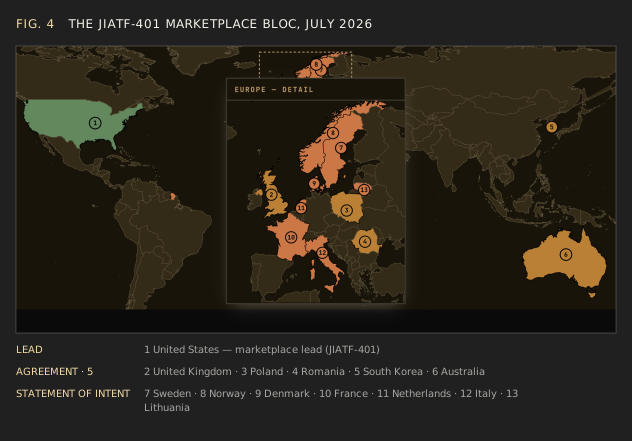
Marketplace lead (United States), procurement-enabling agreements, and Eurosatory statements of intent. Members span four continents; world framing. Instrument and dates per Appendix B, public reporting as of July 15, 2026.
The design is elegant and the reality is early. Four purchases totaling $13 million have moved through the marketplace since February — useful discipline for any revenue model that assumes allied procurement is already flowing. The Eurosatory nine signed a statement of intent, not contracts; the vendor question is not how many flags are on the wall but how many procurement offices route orders through the catalog. And the asymmetry at the center of the design is intentional: the reciprocal channel through which allies would sell to each other is not yet operational, and none has been announced — and dependence on the marketplace concentrates pricing power in a single U.S. contract vehicle.
Until the reciprocal channel opens, this is a place to sell to allies through Washington — which preserves U.S. industrial primacy while offering partners pooled demand. Non-U.S. builders should treat that channel as the indicator that matters most.
The timing logic is already live: qualification compounds. A supplier on the standard gains reach with every accession, while a late entrant faces the queue the marketplace was built to eliminate. The standard is a product requirement now, not a compliance task later.
05 / Position Is the Asset
The terms a pathway trades on — a proven learning curve, a validated test record — are competitive assets, and they accrue to whoever builds them first. Hardware is not where the leverage sits. Pathway position is.
Read together, the two pathways solve the same commercial problem — how does a buyer trust a system it has never fielded? — with opposite instruments: combat proof in one, validated test data in the other. Both are assets a company can build, and both compound: field evidence deepens with every deployment; standard conformance widens reach with every accession. A supplier holding only hardware competes on price inside whichever pathway admits it. A supplier holding the trust asset sets terms — and buyers have already shown which asset they price, bundling data cooperation ahead of hardware volume in the most recent bilaterals. The same tension surfaces in term sheets, transfer expectations on one side and statutory IP retention on the other; the companies that separate what is licensed from what is kept before negotiation keep the compounding asset. The durable position holds both a hub seat and gate conformance — field evidence, converted into multi-buyer revenue. For investors the question is direct: diligence templates still ask what a product does; almost none yet ask which pathway it lives in.
06 / What to Watch
Five indicators will show how this architecture hardens; none requires privileged access.
| Indicator | What to watch | Why it matters |
|---|---|---|
| Fast Track throughput | Permits applied, issued, and shipped over the next 90–180 days under the July 1 decree | The decree is untested at volume; the accumulated backlog will test it before normal deal flow does |
| Reciprocal marketplace channel | The day allies can list systems for other allies to buy | Converts the marketplace from a national export mechanism into a genuine market |
| U.S.–Ukraine framework | Signature, terms, and above all the IP language | Sets the precedent every subsequent negotiator cites |
| Marketplace purchase volume | Orders routed through the catalog, measured against membership count | Flags versus orders — separates political commitment from procurement |
| Battlefield-data template | The first commercial template treating battlefield data as a traded asset | Approaches are being worked out agreement by agreement; the early drafters will shape the category |
The point beneath the five is simple: these pathways are already shaping who can sell what to whom, and most go-to-market plans have not caught up. That gap will close as the architecture hardens — deliberately for those who engage it early, and by force of circumstance for everyone else. Underneath it sits the question the whole architecture turns on, and the cleanest diligence question in the space: who, exactly, has verified that this works where it will be used?
Glossary of Acronyms
- NSDC
- National Security and Defence Council of Ukraine — the presidential-level body coordinating the Drone Deal framework.
- IP
- Intellectual Property — the designs, know-how, and data whose ownership Ukraine’s export regime retains under use-license.
- JIATF-401
- Joint Interagency Task Force 401 — the U.S. Department of War’s central authority for the counter-small-UAS mission; operator of the drone-defense marketplace.
- SOI
- Statement of Intent — a non-binding declaration to pursue marketplace participation, short of a signed procurement agreement.
- IOC
- Initial Operating Capability — the point at which a system or program is first fielded in a usable operational role.
- UAS
- Uncrewed Aircraft System — the drone category the JIATF-401 marketplace is organized to counter (“counter-small-UAS”).
Appendix A — Ukraine Drone Deal Network
As of July 15, 2026
| Country | Status | Detail |
|---|---|---|
| Ukraine | Producer-state hub | Framework coordinated through the NSDC under the Build with Ukraine umbrella |
| Saudi Arabia | Signed | Early tranche |
| United Arab Emirates | Signed | Early tranche |
| Qatar | Signed | Early tranche |
| Azerbaijan | Signed | Early tranche |
| Lithuania | Signed | May 2026 |
| Latvia | Signed | June 2026 |
| Estonia | Signed | July 7, 2026 — Ankara |
| Netherlands | Signed | July 7, 2026 — Ankara |
| Denmark | Signed | July 7, 2026 — Ankara |
| Germany | In preparation | DELTA battlefield-data memorandum and production arrangements; full framework proposed |
| Norway | In preparation | Joint declaration signed; pledge of more than $1.5 billion for Ukrainian-made systems |
| Finland | In preparation | Framework offered May 2026 |
| Canada | In preparation | Production arrangement signed May 2026; full framework pending |
| United States | Testing | Framework unsigned; evaluation under way under signed testing-access documents |
Appendix B — JIATF-401 Marketplace Partners
As of July 15, 2026
| Country | Instrument | Date |
|---|---|---|
| United States | Marketplace lead (JIATF-401) | IOC February 2026 |
| United Kingdom | Procurement-enabling agreement; Eurosatory statement of intent | March / June 2026 |
| Romania | Procurement-enabling agreement | April 2026 |
| Australia | Procurement-enabling agreement | May 2026 |
| Poland | Procurement-enabling agreement; Eurosatory statement of intent | May / June 2026 |
| South Korea | Procurement-enabling agreement | May 2026 |
| Sweden | Statement of intent | June 16, 2026 |
| Denmark | Statement of intent | June 16, 2026 |
| Norway | Statement of intent | June 16, 2026 |
| France | Statement of intent | June 16, 2026 |
| Netherlands | Statement of intent | June 16, 2026 |
| Italy | Statement of intent | June 16, 2026 |
| Lithuania | Statement of intent | June 16, 2026 |
Deal terms and figures per public reporting as of July 15, 2026. Nine-agreement count and Fast Track terms verified against primary reporting (Reuters, Kyiv Post, Ukrainian MoD/Cabinet releases, Interfax-Ukraine, Janes); marketplace-volume figures per the underlying research compilation. This document is provided for informational and discussion purposes only and does not constitute investment advice, a solicitation, or an offer to buy or sell any security. Data, estimates, and projections are drawn from publicly available sources, including government releases, OSINT analysis, and reported figures; they are not independently audited and should be treated as ranges rather than precise values. References to specific companies and institutions are illustrative and do not constitute a recommendation.
